TWO:Finally, a man who, when examined, persists in an obstinate refusal to answer, deserves a punishment[146] fixed by the laws, and one of the heaviest they can inflict, that men may not in this way escape the necessary example they owe to the public. But this punishment is not necessary when it is beyond all doubt that such a person has committed such a crime, questions being useless, in the same way that confession is, when other proofs sufficiently demonstrate guilt And this last case is the most usual, for experience proves that in the majority of trials the accused are wont to plead ¡®Not guilty.¡¯To return to the innocent bankrupt. Granting that his obligation should not be extinguishable by anything short of total payment; granting that he should not be suffered to withdraw from it without the[218] consent of the parties interested, nor to transfer under the dominion of other laws his industry, which should perforce be employed, under penalties, to enable him to satisfy his creditors in proportion to his profits; what fair pretext, I ask, can there be, such as the security of commerce or the sacred right of property, to justify the deprivation of his liberty? Such a deprivation is only of use, when it is sought to discover the secrets of a supposed innocent bankrupt by the evils of servitude, a most unusual circumstance where a rigorous inquiry is instituted. I believe it to be a maxim in legislation, that the amount of political inconveniences varies directly in proportion to the injury they do the public, and inversely in proportion to the difficulty of their proof.
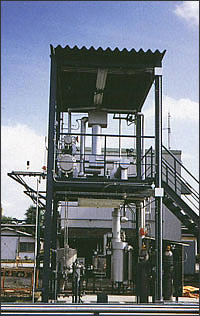
Great attention is recently being paid to global environmental issues, and it is now conceivable that companies will need to treat used solvents themselves. In consideration of this kind of social issue, we have developed a “membrane separation type solvent dehydration system,” which uses a polyimide membrane with superior dehydration properties developed by Ube Industries, Ltd. in combination with our own distillation and concentration technology that has resulted in solvents being more easily recovered.
THREE:But perhaps the best illustrations of the tendency of actions to retain the infamy, attached to them by a past condition of fanatical punishments, are the cases of suicide and child-killing. Could a Greek of the classical period, or a cultivated historian like Plutarch reappear on earth, nothing would strike him more vividly than the modern conception or recent treatment of these crimes. According to Plutarch, Lycurgus, the great Spartan lawgiver, met his death by voluntary starvation, from the persuasion that even the deaths of lawgivers should be of use to mankind, and serve them with an example of virtue and greatness; and Seneca held that it was the part of a wise man not to live as long as he could but as long as he ought. With what astonishment, then, would not Plutarch or Seneca read of recent European punishments for suicide¡ªof Lady Hales[75] losing the estate she was jointly possessed of with her husband, the Judge, because he drowned himself; of the stake and the cross-roads; of the English law which still regards suicide as murder, and condemns one of two men who in a mutual attempt at self-destruction survives the other to the punishment of the ordinary murderer! Is it possible, he would ask, that an action which was once regarded as among the noblest a man could perform, has really come to be looked upon with any other feeling than one of pity or a sad respect?CHAPTER XIX. THE PROMPTNESS OF PUNISHMENTS.
- 1Under the distillation system, even in case of azeotropic solvent compositions, this system which remove water vapor by the polyimide membrane will easily dehydrate.
- 2In comparison with the distillation system, it significantly saves on use of steam.
- 3Dehydration can be performed through merely supplying evaporated vapor to the membrane module and maintaining the differential pressure between the permeable side and the impermeable side.
- 4Solvent purity of 99.9% or more can be achieved by carrying out dehydration with a polyimide membrane only.
- 5The polyimide membrane has superior heat and solvent resistance. Therefore, the vapor permeation system reduces contamination of the membrane and thus extends its life.
THREE:But of far greater historical interest than such criticism is that of Ramsay, the Scotch poet and painter, to whom a copy of Beccaria¡¯s treatise had been shown by Diderot, and who wrote a letter about it to the latter, which, though it contains some very just criticisms on Beccaria, yet reads for the most part very curiously by the light of subsequent history, and illustrates graphically the despair of all reform then felt by most men of reflection.[8]PREFACE.
The aromatic polyimide membrane is highly permeable to water vapor but less permeable to vapors of organic compounds such as alcohol etc.
THREE:Pederasty, so severely punished by the laws, and so readily subjected to the tortures that triumph over innocence, is founded less on the necessities of man, when living in a state of isolation and freedom, than on his passions when living in a state of society and slavery. It derives its force not so much from satiety of pleasure as from the system of education now in vogue, which, beginning by making men useless to themselves in order to make them useful to others, causes, by its too strict seclusion, a waste of all vigorous development, and accelerates the approach of old age.
- 1 Recovery of the detergent solvent Recovery of the cleaning solvent such as electronic parts industry, precision instrument industry.
- 2Solvent recovery and the refinement Solvent recovery and the refinement such as chemical industry, an industry of medical supplies, food industry, the fermentation industry.
THREE:Infanticide equally is the result of the unavoidable dilemma in which a woman is placed who from weakness or by violence has fallen. Finding herself placed between the alternative of infamy on the one side, and the death of a being insentient of its pains on the other, how can she fail to prefer the latter to the infallible misery awaiting both herself and her unhappy offspring? The best way to prevent this crime would be to give efficient legal protection to weakness against tyranny, which exaggerates those vices that cannot be hidden by the cloak of virtue.I speak of probability in connection with crimes, which, to deserve punishment, ought to be proved. But the paradox is only apparent, if one reflects that, strictly speaking, moral certainty is only a probability, but a probability which is called certainty, because every sensible person necessarily assents to it, by a force of habit which arises from the necessity of acting, and which is prior to all speculation. The certainty requisite for certifying that a man is a criminal is, therefore, the same that determines everyone in the most important actions of his life. The proofs of a crime may be divided into ¡®perfect¡¯ and ¡®imperfect,¡¯ the former being of such a[136] nature as exclude the possibility of a man¡¯s innocence, and the latter such as fall short of this certainty. Of the first kind one proof alone is sufficient for condemnation; of the second, or imperfect kind, as many are necessary as suffice to make a single perfect proof; that is to say, when, though each proof taken separately does not exclude the possibility of innocence, yet their convergence on the same point makes such innocence impossible. But let it be noted that imperfect proofs, from which an accused has it in his power to justify himself and declines to do so, become perfect. This moral certainty of proofs, however, is easier to feel than to define with exactitude: for which reason I think that the best law is one which attaches to the chief judge assessors, taken by lot, not by selection, there being in this case more safety in the ignorance which judges by sentiment than in the knowledge which judges by opinion. Where the laws are clear and precise, the function of a judge consists solely in the certification of fact. If for searching out the proofs of a crime ability and cleverness are required, and if in the presentation of the result clearness and precision are essential, all that is required to judge of the result is simple and common good sense, a faculty which is less fallacious than the learning of a judge, accustomed as he is to wish to find men guilty and to reduce everything to an artificial system borrowed from his studies. Happy the nation where the[137] laws are not a science! It is a most useful law that everyone shall be judged by his equals, because where a citizen¡¯s liberty and fortune are at stake those sentiments which inequality inspires should have no voice; that feeling of superiority with which the prosperous man regards the unfortunate one, and that feeling of dislike with which an inferior regards his superior, have no scope in a judgment by one¡¯s equals. But when the crime in question is an offence against a person of a different rank from the accused, then one half of the judges should be the equals of the accused, the other half equals of the plaintiff, that so, every private interest being balanced, by which the appearances of things are involuntarily modified, only the voice of the laws and of truth may be heard. It is also in accordance with justice that an accused person should have power up to a certain point of refusing judges whom he may suspect; and if he is allowed the exercise of this power for some time without opposition, he will seem to condemn himself. Verdicts should be public, and the proofs of guilt public, in order that opinion¡ªwhich is, perhaps, the only bond of society there is¡ªmay place a check on outbursts of force and passion, and that the people may say, ¡®We are not slaves without defence¡¯: a feeling which both inspires them with courage and is as good as a tribute to a sovereign who understands his real interest. I refrain from pointing out other details and precautions which[138] require similar regulations. I should have said nothing at all, had it been necessary for me to say everything.
Acetone, ethanol, methyl ethyl ketone, butanol, isopropyl alcohol, ethyl acetate, methyl isobutyl ketone, others (including hexane and toluene).
